
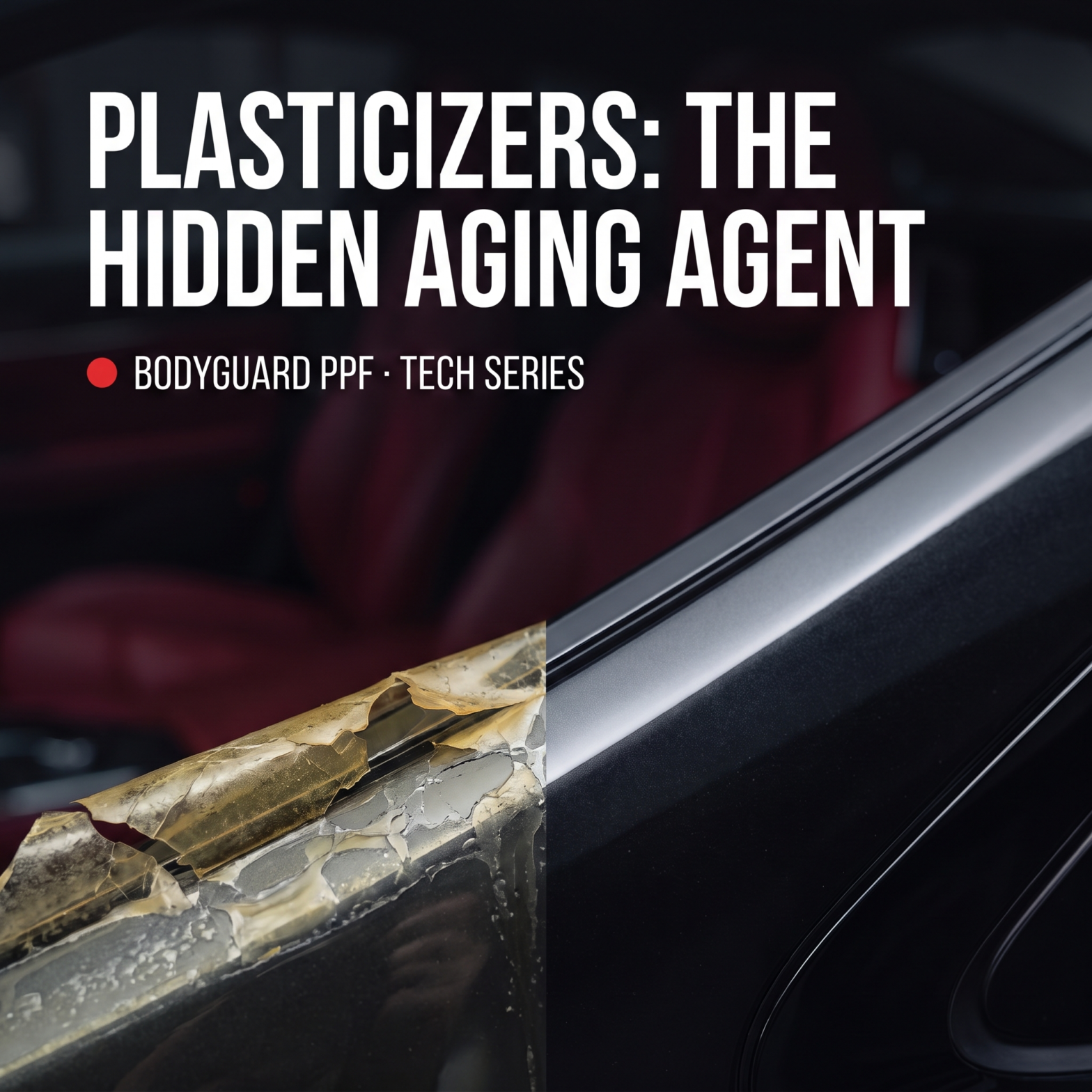
Why does one film still look new after five years while another turns yellow, collects dirt and leaves glue all over the paint when removed? In most cases the answer is one word buyers never hear in a sales pitch: plasticizers. This applies to clear PPF, colored PPF and decorative vinyl alike — which makes it the most useful single concept in film shopping.
What Plasticizers Are
Rigid polymers — PVC above all — are not naturally soft enough to wrap a car. To make them flexible, manufacturers mix in liquid plasticizers, essentially oils. The critical detail: plasticizers are not chemically bonded to the polymer. They sit between its molecules, and over time they migrate out.
How Migration Kills a Film
Heat and UV accelerate the migration, and it goes in two directions. Outward, to the surface: the film becomes tacky, grabs dirt, yellows, then — having lost its softeners — turns brittle and cracks. Downward, into the adhesive: the glue chemistry degrades, producing bubbles, lifting edges and, at removal time, adhesive residue baked onto the paint.
Here is the economics: plasticizer is the cheapest way to make a film soft. So as a rule of thumb, the cheaper the film, the more plasticizer it carries — and the faster this whole sequence plays out. A budget vinyl parked in the sun can show yellowing and brittleness within one to two years.
The Alternative: Softness by Chemistry
Thermoplastic polyurethane takes the other route. TPU is inherently elastic — its flexibility comes from the polymer chemistry itself, not from liquid additives, so it does not depend on plasticizers the way PVC does. That is a core reason premium PPF is TPU-based: there is simply much less in the film that can migrate, evaporate or poison the adhesive. Some manufacturers advertise fully plasticizer-free formulations; the exact percentage is a factory claim, but the principle is solid materials science.
What This Means for Your Car
Practical consequences are easy to picture. Cheap plasticized film after a couple of summers: yellow tint, stiff edges, sticky surface, and a removal job that involves solvents and swearing. A quality TPU film: comes off clean, keeps its edges down for years, and stays optically clear — which is exactly what an 8-year warranty like ours is priced on.
When comparing films, ask directly: does this film contain plasticizers, and what share? A supplier who knows their product will answer without blinking. Explore our TPU range — Gloss, Matte and Color PPF — or write to info@bodyguardfilms.com.