
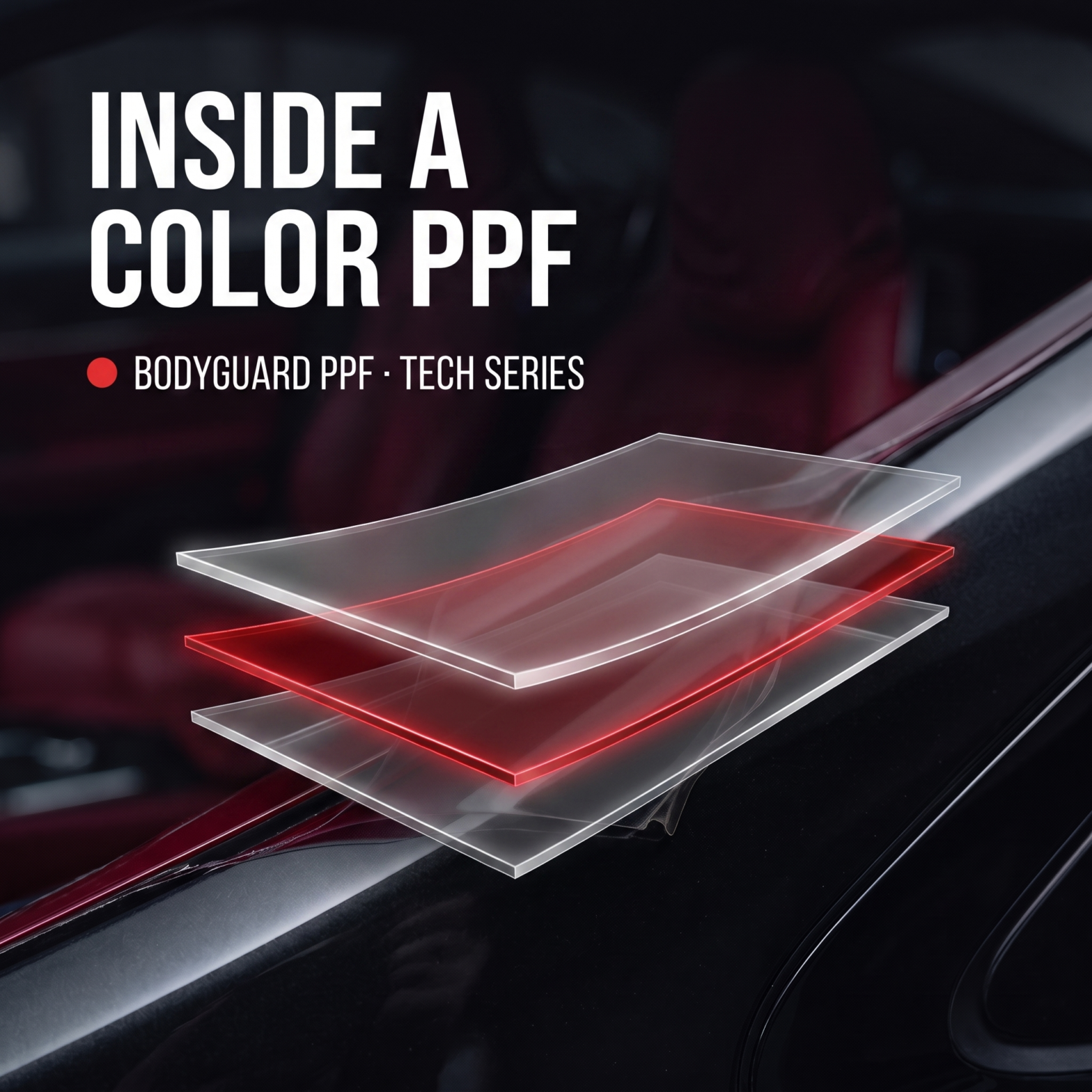
In the previous article we looked at why colored PPF delaminates: stress accumulating at the boundary between dissimilar layers. Today — the practical part. Almost every colored PPF on the market is built one of three ways. Once you can read the “stack”, spec sheets stop being marketing and start being information.
Type A — Single TPU Layer
Structure: TPU → color layer → adhesive. The color is applied to the underside of the TPU film, sitting directly on the adhesive. This is the simplest and cheapest construction to manufacture. The trade-off: the pigment layer is in direct contact with the adhesive, and when the film is stretched hard during installation the color can lighten or micro-crack along edges, because nothing protects it from below.
Type B — TPU Face with a PU Base
Structure: TPU → color layer → PU film → adhesive. Here a polyurethane (but not thermoplastic polyurethane) layer sits under the color. It looks better on paper — the color is protected from both sides. The catch is that TPU and PU are different materials: they react differently to heat, stretch and UV. That mismatch creates stress at the layer boundary, which is the classic precondition for delamination over time. How long that takes depends on climate and installation — there is no independent public test data, so treat lifetime claims with caution.
Type C — Dual TPU “Sandwich”
Structure: TPU face → color layer → TPU base → adhesive. The color is encapsulated between two layers of the same TPU. The engineering logic is sound: identical material above and below the pigment means symmetric behavior under stretch and heat, and no boundary between dissimilar polymers. Some manufacturers additionally claim the two layers are joined by heat fusion rather than adhesive lamination, and quote matched layer thicknesses — reasonable design goals, though such figures are manufacturer claims rather than independently verified data. And any film promising it will “never” delaminate is overpromising: no honest engineer guarantees never.
Why the Stack Matters More Than the Swatch
Internal architecture determines the things you cannot see in a showroom: elasticity and material memory during installation, conformability on complex panels like bumpers and recesses, how edges and wrapped corners hold over the years, chemical compatibility between layers, and long-term stability under weather, heat and UV. Two films that look identical on day one can be completely different products on day five hundred.
Next in the series: plasticizers — the invisible additive that decides whether a film ages gracefully or turns yellow and sticky. Meanwhile, the structure questions worth asking are in our Color PPF overview, or write to info@bodyguardfilms.com.