
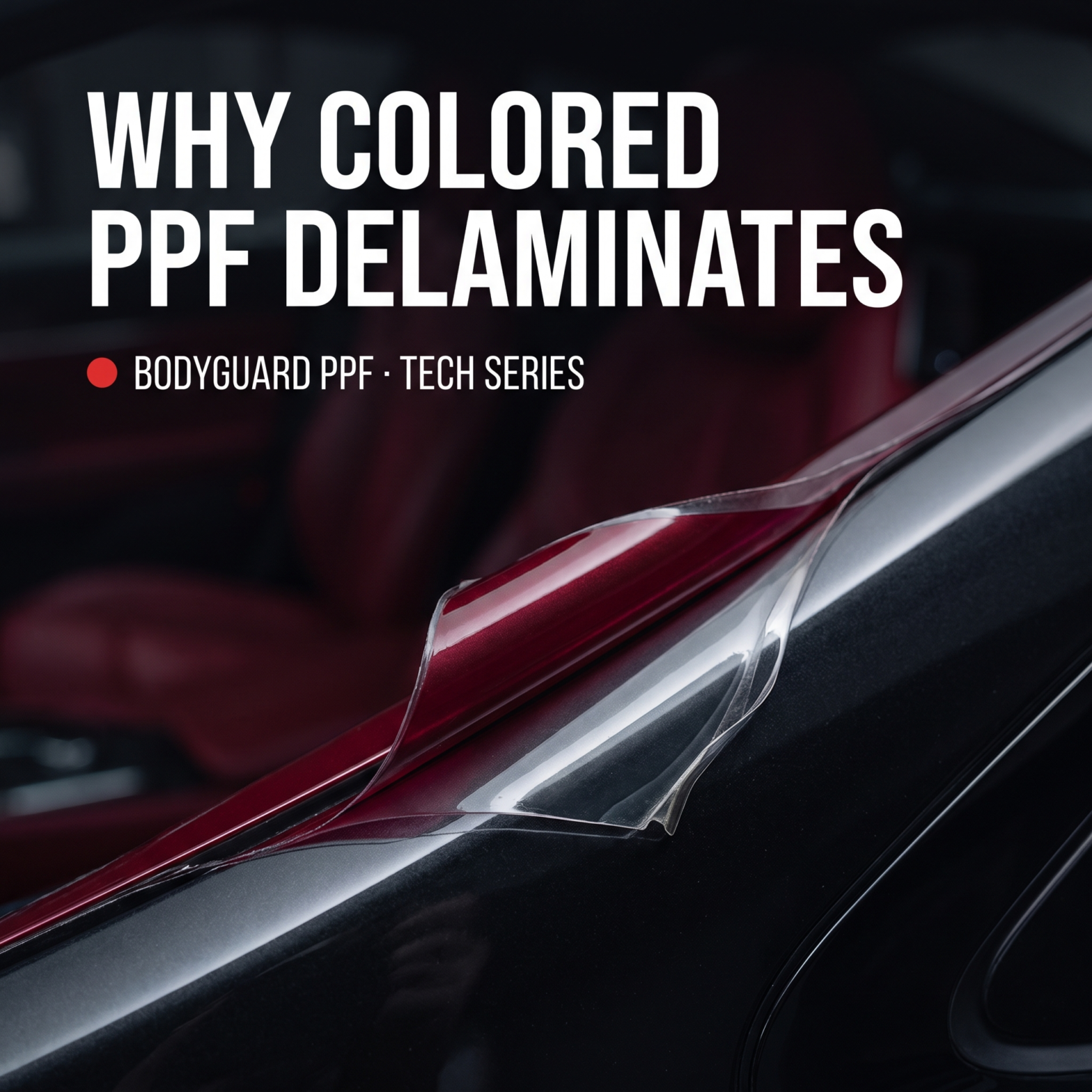
You have seen the photos: a beautiful colored wrap with an edge lifting off the bumper, or a corner where the film seems to be splitting into layers. Delamination is the most common failure mode of colored paint protection film — and it almost never starts on the surface. It starts inside the film, in places you cannot see on a sample swatch.
What Actually Happens
During installation, PPF is stretched — locally up to 20–30% — and heated to conform to curves and recesses. A colored PPF is always a multilayer product: a clear top layer, a color layer, and whatever sits between the color and the adhesive. If those layers are made of different polymers, each one responds differently to that stretch and heat. Different materials have different elastic modulus, different thermal expansion and different residual stress after installation.
The result is shear stress that accumulates exactly at the boundary between dissimilar layers. The car then lives outdoors: UV exposure and daily thermal cycles — day and night, summer and winter — slowly weaken the bond between those layers. The first points of failure are always the same: panel edges, wrapped-under corners, and zones that were stretched the hardest during installation.
Why Cheap Colored Films Fail Faster
The economy in a budget colored film usually hides below the color layer. The top layer may genuinely be TPU — the material every salesperson mentions. But underneath the color you may find a PU or PVC-based layer, or no base layer at all, with the pigment sitting directly on the adhesive. Every one of those shortcuts creates a boundary between materials that age and move differently, and that boundary is where the film eventually lets go.
How to Protect Yourself Before You Buy
Ask your supplier one question that most spec sheets avoid: what is the base layer under the color made of? If the answer is confident and specific — the same aliphatic TPU as the top layer — the film’s structure is symmetric and the layers behave as one material under stress. If the answer is vague, the structure is probably where the price was cut.
Also ask how the layers are joined. Layers fused together in production behave differently from layers glued or laminated after the fact, because lamination adds one more adhesive boundary that can age.
The Bottom Line
Delamination is not bad luck — it is film architecture showing itself over time. When you compare colored PPF options, judge the whole stack, not just the shine of the top coat. In the next article of this series we break down the three film structures on the market and how to tell them apart.
Looking for a colored film engineered as a single system? See BodyGuard Color PPF, or ask us anything at info@bodyguardfilms.com — we are happy to talk structure, not just color charts.